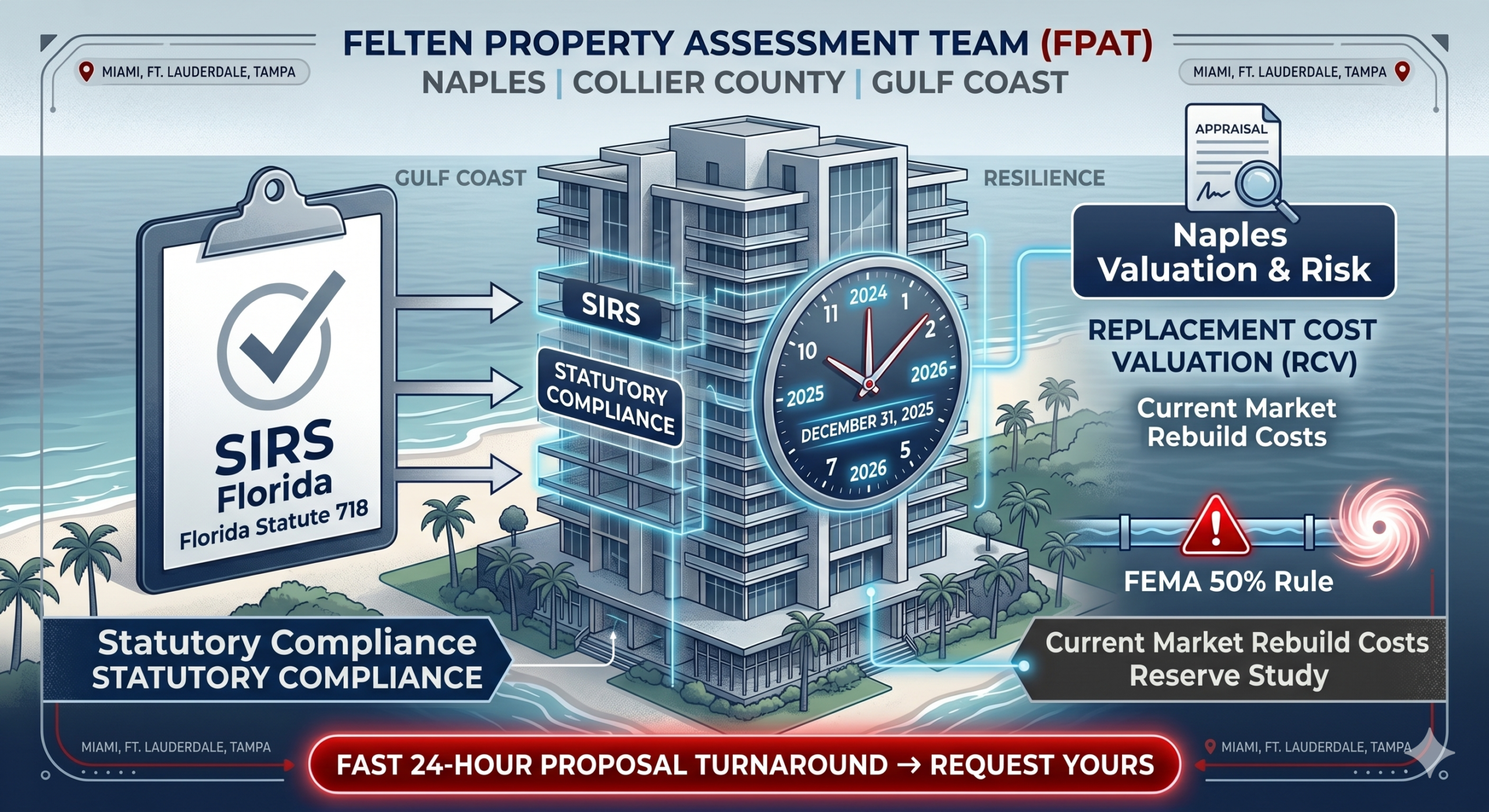

The Definitive 2026 Resource: Integrating your SIRS, HB 913 mandates, and required Replacement Cost Valuations statewide.
The 2026 Florida Condo Compliance Report: SIRS, Appraisals & HB 913
The grace period is officially over. With the December 31, 2025 deadline for initial Structural Integrity Reserve Studies (SIRS) behind us, Florida’s condominium and cooperative boards have entered a new era of strict financial and structural accountability. Navigating the intersection of property valuation and reserve funding is no longer just a best practice—it is the law.
As the Lead Consultant for the Felten Property Assessment Team (FPAT), I have guided hundreds of associations from Miami to Tampa through this legislative maze. This guide serves as the definitive reference for Florida property managers and board members who need to secure accurate Insurance Appraisals, comply with Florida Statute 718, and navigate the rigid reserve requirements enforced in 2026.
Florida Statute 718.111(11): The 36-Month Valuation Law
Under Florida Statute 718.111(11), every condominium association in the state must independently appraise its property to determine the precise replacement cost of the insured property at least once every 36 months.
Why this matters right now: In today’s volatile insurance market, carriers are demanding updated Replacement Cost Valuations (RCV) well before the 36-month mark. Failing to provide a professionally certified RCV can result in massive co-insurance penalties, slashed coverage, or outright policy non-renewal. Your board must insure the property for what it costs to rebuild it today, not what it could sell for on the real estate market.
Deep dive into the legal specifics in our Complete Guide to FL Statute 718 Appraisals.
The Post-2025 SIRS Reality & HB 913 Updates
The tragic events at Surfside led to the creation of the Structural Integrity Reserve Study (SIRS). For all condos and co-ops three stories or taller, the mandate is clear:
- Zero Waivers: As of 2026, it is illegal for boards to vote to waive or underfund reserves for critical structural components (roofs, foundations, load-bearing walls, fireproofing, etc.).
- HB 913 Adjustments: While recent legislation (HB 913) provided minor procedural clarifications and alternative funding options (like securing lines of credit with majority unit-owner approval), the core mandate remains absolute. Your current 2026 budget must reflect the funding schedule dictated by your SIRS.
To maximize efficiency and lower costs, top-performing boards across Florida are now legally bundling their required Insurance Appraisals with their SIRS site inspections. Learn how FPAT executes this dual-compliance strategy in our SIRS Florida Overview.
Statewide Action: Fast 24-Hour Proposal Turnaround
Whether you are battling the FEMA 50% Rule on the Gulf Coast or facing inland windstorm risks in Orlando, compliance cannot wait. FPAT guarantees a Fast 24-Hour Proposal Turnaround for all Florida associations. Protect your board from liability and secure your community’s future.
Request Your Free Statewide ProposalFlorida Compliance FAQ: 2026 Updates
The most cited legal & structural questions from Florida Boards
Can a Florida condo board waive reserves in 2026?
No. Following the expiration of the initial grace period and updates finalized in HB 913, Florida condominium boards can no longer vote to waive or underfund reserves for the specific structural components mandated in a Structural Integrity Reserve Study (SIRS). Full funding per the study's schedule is now a strict legal requirement.
How often is a Florida condo required to get an insurance appraisal?
Per Florida Statute 718.111(11), condominium associations must obtain an independent insurance appraisal to determine the replacement cost of the property at least once every 36 months. However, due to rapid inflation and strict insurance underwriting, many carriers now require updates every 12 to 24 months to prevent co-insurance penalties.
What buildings are exempt from SIRS in Florida?
Under current Florida law, condominiums and cooperatives that are one or two stories in height are entirely exempt from the Structural Integrity Reserve Study (SIRS) requirement. Additionally, single-family home HOAs governed under Chapter 720 are exempt, though they still have fiduciary duties to maintain standard reserve studies for common elements.