
Special Assessment Examples: What They Are and How to Avoid Surprises
What a Special Assessment in Real Estate Actually Means (And Why It Matters)
What is a special assessment in real estate? It’s an extra charge — separate from regular taxes or HOA dues — that property owners must pay when a government authority or homeowners association needs to fund a specific project or repair that wasn’t covered by existing budgets or reserves.
Here’s a quick breakdown:
| HOA Special Assessment | Government Special Assessment | |
|---|---|---|
| Issued by | Homeowners association or condo board | Municipality, county, or public authority |
| Common triggers | Roof repairs, storm damage, reserve shortfalls | Road paving, sewer lines, sidewalk repairs |
| Who pays | Property owners in the community | Property owners in the benefit district |
| How it’s collected | Lump sum or added to monthly dues | One-time fee or annual installments |
| Transferable at sale? | Often yes, unless negotiated | Can attach to title and transfer to buyer |
For Florida condo and HOA boards, special assessments are one of the most stressful financial events a community can face. They arrive suddenly, they can run into the tens of thousands of dollars per unit, and they often signal that something went wrong in the financial planning process long before the bill arrived.
About 70% of U.S. community associations are underfunded — meaning their reserves hold less than 70% of what they actually need. When a major repair hits and the money isn’t there, a special assessment is almost always the result.
I’m Eric Dixon, RS, GCS Class A — a CAI Licensed Reserve Specialist and Partner at FPAT with over 20 years of experience helping Florida HOAs and condo communities understand what is a special assessment in real estate and, more importantly, how to avoid one. In the sections below, I’ll walk you through everything you need to know — from how assessments are triggered and calculated, to your rights as a homeowner and your obligations as a buyer or seller.
What Is a Special Assessment in Real Estate?
To truly grasp what is a special assessment in real estate, it helps to look at it as a financial safety valve—or, from the homeowner’s perspective, an emergency bill. When you purchase a property within a managed community (like a condominium in Miami FL or a townhome in Tampa FL), you agree to pay regular maintenance fees. These fees keep the lights on in the lobby, pay for pool chemicals, and theoretically fund a savings account for future repairs.
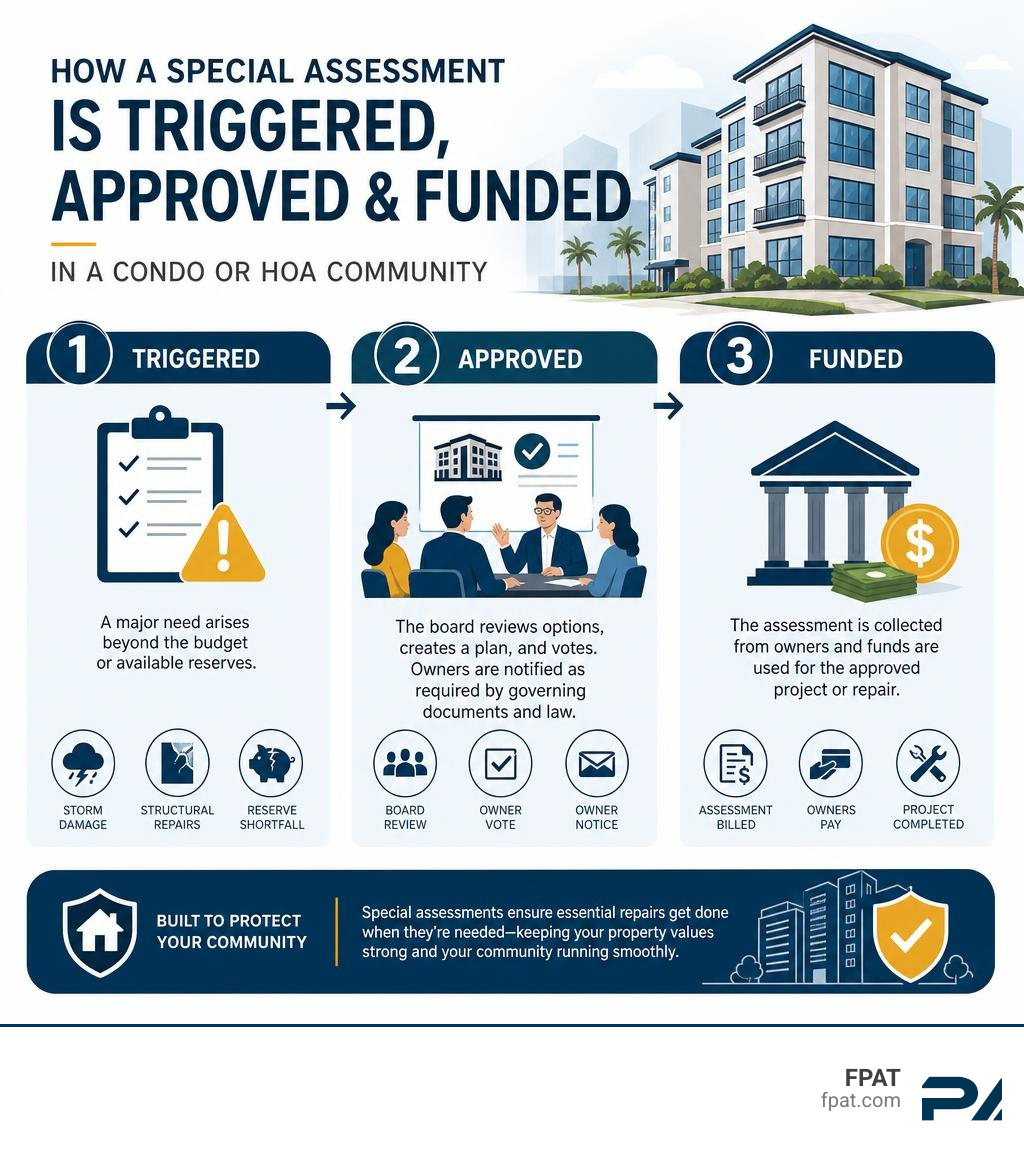
However, life happens. A severe storm might rip through Fort Lauderdale FL, damaging the clubhouse roof. Or, years of deferred maintenance might catch up to a high-rise in St. Petersburg FL, requiring immediate structural reinforcement. When these unexpected expenses, major capital improvements, or sudden budget shortfalls exceed what the community has saved, the board cannot simply wish the money into existence. They must levy a special assessment.
This is fundamentally different from a Special assessment tax , which is imposed by a local government authority rather than a private housing board. While both are involuntary charges tied directly to your property, their origins, legal structures, and purposes differ significantly.
Understanding the Basics of What Is a Special Assessment in Real Estate
In a typical community association, your monthly or quarterly HOA fees are divided into two main buckets: operating expenses (day-to-day costs) and reserve funds (long-term savings for capital components like roofs, paving, and painting).
Additionally, the association maintains a master insurance policy to cover major damage to shared spaces. But what happens if a disaster strike causes damage that falls below the policy’s high deductible? Or what if the master policy limits are simply exceeded?
When the reserve funds are dry and the insurance policy won’t cover the difference, the board must issue a special assessment. It is a separate, legally binding bill sent to every homeowner. As highlighted in Special Assessments: The Homeowner Fee Nobody Warns You About | Arcanomy™ , these assessments are rarely highlighted by enthusiastic real estate agents during the buying process, making them one of the most shocking financial surprises a new homeowner can experience.
HOA Special Assessments vs. Government-Imposed Special Assessments
While we often focus on private communities, local municipal governments also use special assessments to fund public infrastructure. If your local municipality in Orlando FL or Jacksonville FL decides to pave a dirt road, install new drinking water lines, or build a municipal parking garage, they may establish a Special Assessment District (SAD).
Under this setup, only the specific properties that directly benefit from the improvement are charged. For a deeper dive into how public entities structure these charges, the Federal Highway Administration provides a comprehensive resource in their Frequently Asked Questions – Special Assessments .
Here is how these two types of assessments stack up:
| Feature | HOA Special Assessment | Government Special Assessment |
|---|---|---|
| Primary Authority | HOA or Condo Board of Directors | City Council, County Commission, or Public Utility |
| Legal Basis | Community CC&Rs and State Statutes | State Enabling Legislation and Local Ordinances |
| Calculation Method | Divided equally or by unit square footage | Front-footage, land value, or per-property basis |
| Tax Deductibility | Non-deductible (increases property cost basis) | Non-deductible (unless for maintenance/interest) |
| Primary Purpose | Private community repairs and capital projects | Public infrastructure (roads, sewers, sidewalks) |
Common Reasons for Special Assessments and How Costs Are Divided

Special assessments do not happen in a vacuum. They are almost always the direct result of a gap between physical reality and financial planning. Common physical triggers include replacing an aging roof, repaving miles of private community roads, repairing structural concrete, or upgrading outdated elevator systems.
When structural integrity is compromised, boards have a fiduciary duty to act. They cannot ignore a failing structural column or a leaking roof. To prevent these sudden financial crises, proactive communities rely on professional reserve studies. For a detailed guide on how to align your physical assets with your financial goals, see our comprehensive resource on Financial Planning for HOAs: The Role of Reserve Studies.
Why Underfunded Reserves Trigger What Is a Special Assessment in Real Estate
The number one culprit behind massive special assessments is underfunded reserves. For decades, many condo and HOA boards in Florida kept monthly dues artificially low to keep homeowners happy. They did this by repeatedly voting to waive or reduce reserve funding.
This short-sighted strategy backfired. In the wake of recent structural safety legislation, Florida has implemented strict compliance standards. By 2026, structural integrity reserve studies (SIRS) are mandatory for many buildings, and boards are legally prohibited from waiving the funding of structural reserves.
If your community has a massive reserve deficit and years of deferred maintenance, you are facing a perfect storm. To understand why keeping your physical and financial evaluations up to date is no longer optional, read our expert analysis on Why Regular Updates to Your Reserve Study Are Crucial.
How Special Assessment Costs Are Calculated and Collected
When a special assessment is approved, the total cost of the project is divided among the property owners. The method of division is dictated by the community’s governing documents (the CC&Rs).
Typically, costs are divided in one of two ways:
- Equal Split: The total cost is divided equally by the number of units. For example, if a 50-unit building in Clearwater FL needs a $50,000 roof repair, each resident is billed exactly $1,000.
- Square Footage / Percentage of Ownership: Owners of larger units pay a larger share of the assessment because they own a higher percentage of the common elements.
Once calculated, the board determines the payment schedule. Homeowners may be required to pay a single lump-sum payment by a specific deadline, or they may be offered installment plans (e.g., monthly payments spread over one to five years).
While some states, like California, place a strict 5% cap on annual special assessments without a membership vote, Florida law focuses heavily on structural safety and mandatory funding, meaning boards often have the direct authority—and legal obligation—to pass large assessments to keep buildings structurally sound.
Proposed vs. Confirmed Special Assessments: Key Differences
In real estate transactions, timing is everything. Understanding the distinction between a proposed special assessment and a confirmed special assessment is critical, as it determines who is legally responsible for paying the bill.
For real estate professionals navigating these waters, the North Carolina Association of Realtors provides an excellent framework in their SPECIAL ASSESSMENTS broker guide, which highlights how critical these definitions are during contract negotiations.
What Is a Proposed Special Assessment?
A proposed special assessment is one that is under formal consideration but has not yet been officially approved by a vote of the board or the membership.
This stage typically begins when:
- The board discusses a major project (like a pool resurfacing or elevator modernization) during a duly-called meeting.
- The community’s meeting minutes reflect that bids are being gathered for a large-scale repair.
- A formal notice of a meeting to discuss a potential assessment has been sent to owners.
At this stage, the assessment is a potential liability. It is not yet legally binding, but it is a material fact that must be disclosed to prospective buyers. For more information on how consumers should view these pending liabilities, refer to the SPECIAL ASSESSMENTS consumer guide.
What Is a Confirmed Special Assessment?
A confirmed special assessment is one that has been formally approved and adopted by the board of directors or the association’s membership prior to the settlement date.
Once confirmed, the assessment becomes a legally binding debt. The resolution will outline the total amount, the payment schedule, and the due dates. Even if the payments are structured to be paid in future installments extending long after the closing date, the assessment itself is considered “confirmed” because the legal obligation was established prior to closing. For precise legal definitions of these terms, you can consult the Special Assessment Legal Glossary.
Buyer vs. Seller Responsibilities and Disclosure Requirements

When a property with an active or pending special assessment is sold, it often sparks intense negotiations. Who pays the bill? The answer depends on the terms of the real estate contract and local disclosure laws.
In Florida, standard FAR/BAR contracts contain specific provisions addressing special assessments. To understand how these issues are legally navigated in South Florida’s high-stakes condo market, check out the legal insights in What Buyers and Sellers Need to Know About Special Assessments.
Seller Disclosure Obligations for Proposed and Confirmed Assessments
Sellers have a strict legal obligation to disclose all material facts affecting the value or desirability of the property. A proposed or confirmed special assessment is, without question, a material fact.
- Proposed Assessments: Sellers must disclose any proposed assessments they are aware of to the best of their knowledge. Failing to disclose that the board has been actively discussing a $20,000 structural repair in recent meetings can lead to severe post-closing legal disputes.
- Confirmed Assessments: Sellers must warrant the existence of any confirmed assessments. If a seller fails to disclose a confirmed assessment, they are in breach of contract and can be held liable for the full amount, even if the buyer discovers it after closing.
For a detailed look at how real estate agents should handle these disclosures to protect their clients, refer to Understanding Special Assessments for Realtors.
Who Pays? Negotiating Special Assessments in a Real Estate Transaction
In a standard transaction, the default rule is often that the seller pays confirmed assessments in full at or before closing, while the buyer takes title subject to proposed assessments.
However, everything is negotiable. Common negotiation strategies include:
- Price Reductions: The seller reduces the purchase price of the home by the amount of the special assessment, allowing the buyer to assume the future payments.
- Escrow Holdbacks: A portion of the seller’s proceeds is held in an escrow account at closing to pay the assessment installments as they come due.
- Installment Transfers: The buyer agrees to take over the monthly assessment installment payments post-closing, usually in exchange for other concessions.
Homeowner Rights, Non-Payment, and Buyer Due Diligence
As a homeowner, receiving a five-figure special assessment bill can feel incredibly disempowering. However, you do have rights, and buyers have a responsibility to perform deep due diligence before signing on the dotted line. To understand why a proactive reserve study is your community’s best defense against these financial surprises, read our guide on the Top 5 Reasons Reserve Study Florida.
How to Challenge or Protest an Assessment
If you believe a special assessment was levied unfairly or illegally, you can take action:
- Review the CC&Rs: Verify that the board followed the correct legal procedures outlined in the community’s governing documents. Did they give proper notice of the meeting? Did they require a community vote if the assessment exceeded a certain financial threshold?
- Attend Board Meetings: Gather with your neighbors to voice concerns, ask for alternative bids, or suggest extending the payment timeline.
- Request Mediation: Many state laws and association documents encourage or require internal dispute resolution or mediation before taking legal action.
- Consult Legal Counsel: If the board skipped mandatory statutory steps, an attorney specializing in community association law can help you file a formal challenge.
The Severe Consequences of Late or Non-Payment
While you have the right to ask questions, simply refusing to pay a legally sound special assessment is a dangerous path. The consequences are severe and swift:
- Late Fees and Interest Charges: Associations will quickly tack on late fees and high interest rates to the unpaid balance.
- Loss of Amenities: Your access to the community pool, gym, or parking spaces may be suspended.
- Assessment Liens: The association has the legal right to place a lien against your property for the unpaid balance.
- Foreclosure Risk: In Florida, community associations can foreclose on an assessment lien, forcing the sale of your home to recover the debt—even if you have a primary mortgage.
Essential Due Diligence Steps for Condo and HOA Buyers
If you are buying a condo or home in a managed community in Safety Harbor FL, Sarasota FL, or Naples FL, you must protect yourself from inheriting a financial nightmare.
Never buy blindly. Perform these critical due diligence steps:
- Request the Reserve Study: Look at the “percent funded” level. If it is under 30%, the community is at high risk for a special assessment.
- Review Board Meeting Minutes: Request the last 12 to 24 months of meeting minutes. Look for discussions about building repairs, structural concerns, or budget deficits.
- Analyze the Financials: Look at the association’s balance sheet. Are they actively saving, or are they operating on a shoestring budget?
- Understand Florida Legislation: Ensure the building is compliant with recent structural laws. For a clear breakdown of how the state regulates condo safety, read our guide on Understanding HB 913 and How FPAT Can Help.
Frequently Asked Questions about Special Assessments
Are HOA special assessments tax-deductible?
Generally, no. For a primary residence, HOA special assessments are not tax-deductible on your federal income tax return. However, if the assessment was used for a capital improvement (like a new roof or structural repairs), you can add the cost of the assessment to your property’s cost basis. This can reduce your capital gains tax liability when you eventually sell the home. If the property is a rental or investment property, the assessment may be deductible as a business expense, depending on whether it is classified as a repair or an improvement. Always consult a qualified tax professional.
Does standard condo insurance cover special assessments?
A standard HO-6 condo insurance policy does not automatically cover special assessments. However, you can add a highly recommended endorsement called Loss Assessment Coverage. This coverage protects you if the association passes a special assessment due to a covered peril (such as windstorm damage to common areas) or a liability claim that exceeds the master policy’s limits. It typically does not cover assessments triggered by deferred maintenance, general wear and tear, or underfunded reserves.
Can a special assessment be paid in installments?
Yes, in many cases. Because boards recognize that a sudden $15,000 bill is a massive financial burden for most families, they frequently offer installment plans. These plans allow owners to pay the assessment over 12 months, 5 years, or even longer. That some associations may charge interest on these payment plans to cover the cost of any bank loans they had to secure to fund the project upfront.
Conclusion
At the end of the day, understanding what is a special assessment in real estate is about recognizing the connection between physical structural health and long-term financial planning. Special assessments are not random acts of bad luck; they are almost always the predictable consequence of deferred maintenance and underfunded reserves.
For condo and HOA boards across Florida—from Tallahassee FL down to Boca Raton FL—proactive financial management is the only way to protect your owners from devastating financial surprises.
At FPAT, we specialize in helping communities navigate these challenges. We provide comprehensive reserve studies, accurate insurance appraisals, and thorough windstorm inspections. With our industry-leading 24-hour proposal turnaround and deep expertise in Florida compliance (including HB 913 and SIRS requirements), we help you plan for the future with confidence.
Don’t wait for a structural emergency to force your hand. Contact us today to secure your community’s financial future, and read our expert guide on Avoiding Special Assessments: A Guide for Florida Condos to learn more.