
The Ultimate Guide to Community Association Reserve Studies
Why Every HOA and Condo Board Needs an Association Reserve Study
An association reserve study is a professional financial and physical planning tool that tells your community how much money to set aside each year for future repairs and replacements of major common-area components — things like roofs, elevators, parking lots, and pool decks.
If you’re a board member looking for a quick answer, here’s what you need to know:
| Question | Quick Answer |
|---|---|
| What is it? | A report analyzing your property’s physical condition and reserve fund health |
| Who needs one? | HOAs, condo associations, co-ops, and property owners’ associations |
| How often? | Every 3-5 years, with annual reviews |
| Why does it matter? | Prevents surprise special assessments and keeps your community financially stable |
| Is it required? | Yes, in many states — including Florida, California, and Virginia |
Without a reserve study, your board is making financial decisions without a map. You don’t know what’s wearing out, when it will need replacement, or whether you have enough money to cover it. That’s a stressful — and risky — place to be, especially in Florida, where hurricanes, heat, and humidity accelerate the wear on buildings faster than almost anywhere else in the country.
The good news: a proper reserve study gives you clarity, confidence, and a defensible plan.
I’m Eric Dixon, RS, a CAI Licensed Reserve Specialist and Managing Member at FPAT, with over 20 years of hands-on experience conducting association reserve studies across Florida — from traditional HOA studies to complex Structural Integrity Reserve Studies (SIRS) for high-rise condominiums. I’ve worked with communities in Orlando, Tampa, Gainesville, Clearwater, and beyond, helping boards turn overwhelming compliance requirements into straightforward, actionable funding plans.
What is an Association Reserve Study and Why Does It Matter?
At its heart, an association reserve study is a reality check for your community’s physical and financial health. Every building, clubhouse, paved road, and pool pump has a finite lifespan. As these components slowly degrade, they represent a growing liability for the association.
Board members have a strict fiduciary duty to protect, maintain, and manage the community’s common elements. Ignoring this duty or failing to plan for the inevitable wear and tear is where many associations run into trouble. When roofs leak or elevators fail, the money has to come from somewhere. If there are no reserves on hand, the board must resort to deferred maintenance—which only makes the eventual repairs more expensive—or hit homeowners with sudden, massive special assessments.
A reserve study shines a light on these future obligations. It serves as a 30-year capital planning tool, mapping out when major projects will occur and how much they will cost. By understanding this timeline, boards can transition from reactive crisis management to proactive stewardship. For a deeper look into how these studies shape your community’s financial future, check out our guide on Financial Planning for HOAs: The Role of Reserve Studies.
The Core Purpose of an Association Reserve Study
The primary purpose of a reserve study is to provide clear, professional recommendations on the amount of money your community should set aside annually. This annual contribution offsets the ongoing daily deterioration of your shared physical assets.
According to CAI’S RESERVE STUDY standards, a reserve study acts like an investment strategy. Rather than forcing future owners to pay for decades of wear and tear they didn’t fully cause, a reserve study ensures that every owner contributes their fair share of depreciation over time. This creates an equitable distribution of costs and ensures the association has sufficient cash on hand to execute projects precisely when they are needed.
How Reserve Studies Protect Property Values and Prevent Special Assessments
When a community is visibly well-maintained, property values naturally rise. Buyers are savvy; they don’t just look at the granite countertops inside a unit. They look at the condition of the roofs, the quality of the asphalt, and—most importantly—the health of the reserve fund.
A well-funded reserve account is the ultimate defense against special assessments. These surprise bills can cause immense financial stress for homeowners, lead to neighborhood conflict, and even trigger foreclosures. In contrast, communities that maintain strong reserves enjoy a low risk of special assessments. Buyers are willing to pay a premium for homes in communities where they know they won’t be hit with a sudden $20,000 bill to replace a clubhouse roof. To learn more about safeguarding your community, read our expert advice on Avoiding Special Assessments: A Guide for Florida Condos.
Key Components of a Professional Reserve Study
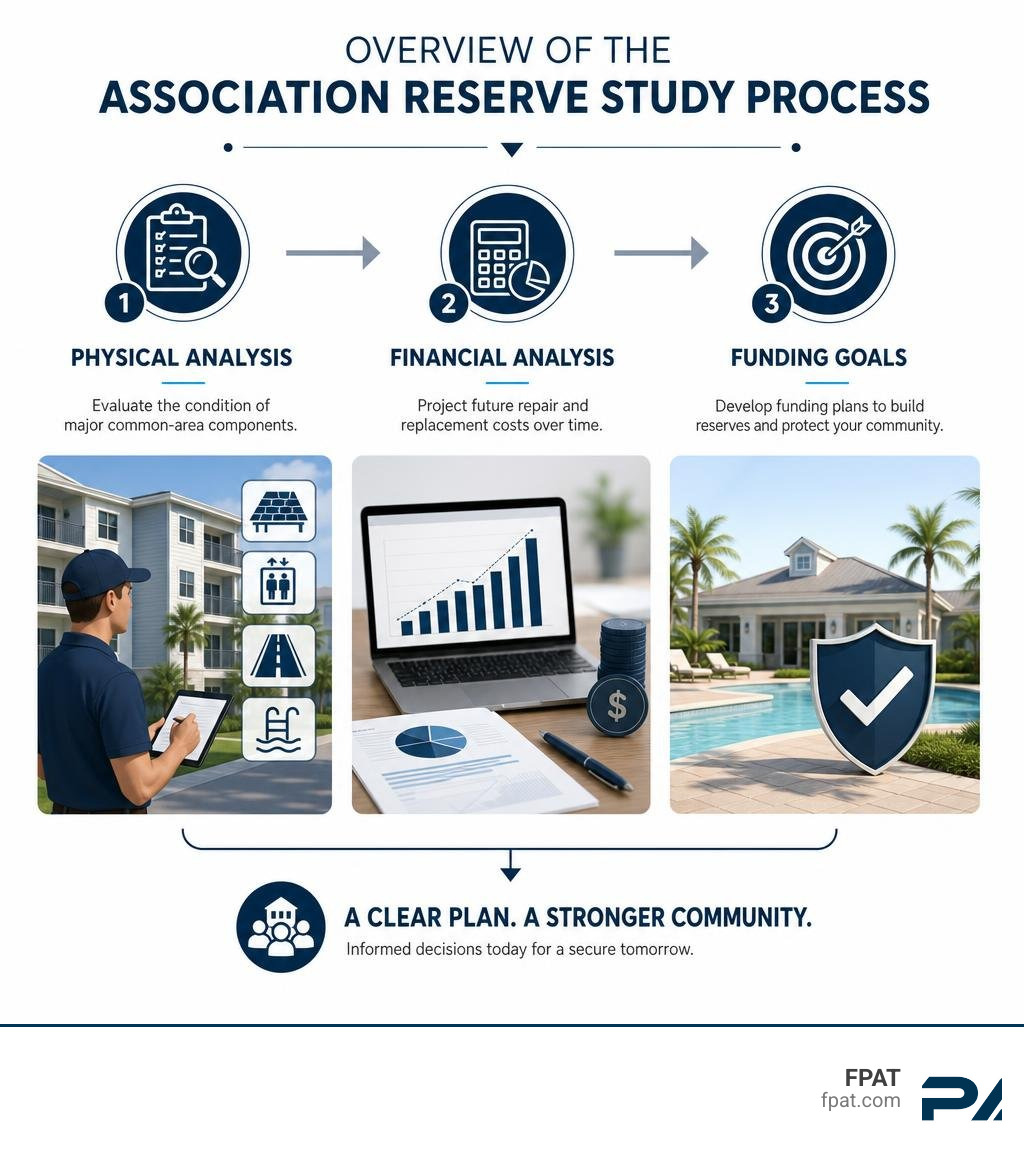
A professional association reserve study is divided into two distinct parts: the Physical Analysis and the Financial Analysis. Together, they answer two fundamental questions: What do we own, and how are we going to pay to keep it in good shape?
To understand how these two sides of the study work together, let’s look at their core focuses:
| Physical Analysis (The Fieldwork) | Financial Analysis (The Math) |
|---|---|
| Component Inventory (What do we maintain?) | Current Reserve Fund Balance |
| Condition Assessment (What shape is it in?) | Fully Funded Balance (FFB) Calculation |
| Useful Life & Remaining Useful Life Estimates | Percent Funded Evaluation |
| Current Replacement Cost Estimates | 30-Year Funding Plan & Cash Flow Projections |
Physical Analysis: Assessing the Property’s Condition
The Physical Analysis begins with a thorough onsite visual inspection. A qualified reserve professional walks the property to identify and evaluate all common-area components.
To determine which physical assets belong in the study, we apply the three-part national-standard test established in the CAI Reserve Study Standards May 2023 – FINAL :
- Association Obligation: The component must be the association’s legal responsibility to maintain or replace.
- Predictable Life Limit: The component must have a limited, predictable useful life.
- Material Cost: The repair or replacement cost must be material—typically meaning it exceeds 0.5% to 1% of the association’s total annual budget.
During the site visit, the specialist estimates the useful life (how long the component lasts from installation to replacement) and the remaining useful life (how many years are left before it must be replaced) for each item, alongside current local market replacement costs.
Financial Analysis: Evaluating the Reserve Fund Status
Once we have a complete inventory and cost projection for all components, we move to the Financial Analysis. This phase measures the strength of your current reserve fund relative to the deterioration of your property.
A key metric here is the Fully Funded Balance (FFB). This represents the theoretical amount of money that should be in your reserve fund at any given moment to match the precise age and wear of your assets. The formula is straightforward:
$$\text{Fully Funded Balance} = \text{Current Replacement Cost} \times \left( \frac{\text{Effective Age}}{\text{Useful Life}} \right)$$
By comparing your actual cash reserves to the FFB, we calculate your Percent Funded:
- Strong (70% – 130% Funded): Extremely low risk of special assessments. The association is in excellent financial health.
- Fair (30% – 69% Funded): Moderate risk. Boards should plan gradual contribution increases to build a safer cushion.
- Weak (Below 30% Funded): High risk of deferred maintenance, component failure, and emergency special assessments.
For detailed guidelines on how these calculations are structured to support healthy association budgets, you can refer to the Reserve Study Guidelines for Homeowner Association Budgets .
Reserve Funding Models and Goals for HOA Boards
When building a long-term funding plan, boards must decide on a funding goal that matches their community’s risk tolerance.

Full Funding (100% Funded)
The Full Funding model is the gold standard of reserve planning. The goal is to keep the reserve fund balance at or near 100% of the Fully Funded Balance.
This model is highly recommended because it is simple, responsible, and equitable. It ensures that the cash in the bank always matches the exact value of component deterioration. Because the fund is robust, the association can easily absorb unexpected price hikes, supply chain delays, or premature component failures without risking financial instability.
Baseline and Threshold Funding Goals
If Full Funding feels out of reach for an underfunded community, boards often look at alternative strategies:
- Baseline Funding: This is the most aggressive (and risky) model. The goal is simply to keep the reserve balance above zero dollars at all times over the 30-year projection. While it keeps assessments low in the short term, it leaves absolutely no room for error. A single unexpected storm or inflation spike can push the association into a deficit, forcing a special assessment.
- Threshold Funding: This model establishes a safety cushion—such as keeping the fund at a minimum of 30% or 50% funded, or keeping a specific cash minimum in the account. It offers a middle ground between the safety of Full Funding and the lower immediate contribution rates of Baseline Funding.
Legal Requirements and State Mandates
While reserve studies are a smart business practice, they are also increasingly mandated by law. Many states recognize that underfunded communities pose a threat to structural safety and consumer protection.

California and Virginia Reserve Study Laws
Other states have long established strict rules for reserve planning:
- California: Under the state’s Common Interest Development Act, boards must conduct a visual inspection of major components every three years if their replacement value equals or exceeds half of the association’s gross budget. They must also review and update the study annually. For more details on these West Coast standards, see the Reserve Study Guidelines for Homeowner Association Budgets .
- Virginia: Property owners’ associations are legally mandated by the Code of Virginia to conduct a reserve study at least once every five years and review the results annually to adjust budgets and assessments accordingly.
Florida’s Evolving Regulations: SIRS and HB 913
In Florida, the regulatory landscape changed dramatically following the Champlain Towers South tragedy in Surfside. The state realized that allowing associations to continuously waive reserve funding for critical structural components was a safety hazard.
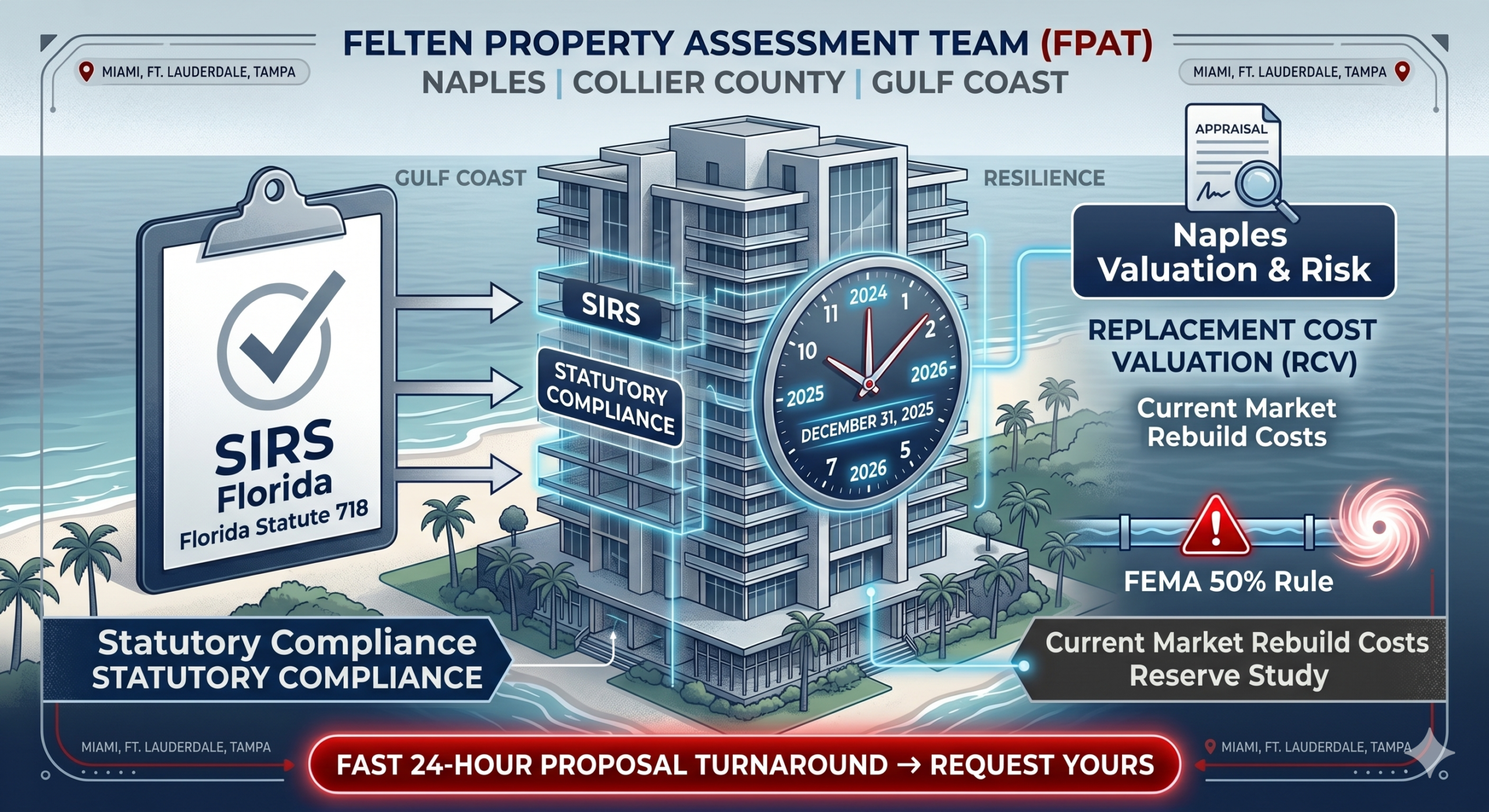
Today, Florida condo and co-op buildings that are three stories or higher must complete a Structural Integrity Reserve Study (SIRS). A SIRS is a specialized reserve study focusing specifically on components critical to the structural safety of the building, including:
- Roofs
- Load-bearing walls and primary structural members
- Fireproofing and fire protection systems
- Plumbing
- Electrical systems
- Waterproofing and exterior painting
- Windows and exterior doors
Unlike traditional studies where boards can vote to waive or reduce funding, Florida law now prohibits waiving or underfunding reserves for these critical SIRS components. To understand how these new requirements differ from what your community might be used to, read our breakdown of The Difference Between Traditional and SIRS Reserve Studies. Additionally, recent legislative updates like HB 913 have refined these compliance timelines and developer requirements. You can stay ahead of these changes by Understanding HB 913 and How FPAT Can Help.
How to Choose a Qualified Reserve Study Professional
Selecting the right partner to conduct your association reserve study is critical. You are trusting this firm to inspect millions of dollars of physical assets and map out your community’s financial roadmap for the next three decades.
If you are looking for a trusted provider in Florida, we’ve put together a comprehensive guide on How to Find the Right Reserve Study Company in Florida. While cost is always a factor, choosing the cheapest bid can often result in missed components, inaccurate lifespans, and future budget shortfalls. To understand what goes into these professional fees, read our breakdown of Reserve Study Cost Florida.
Key Qualifications to Look For in a Provider
When vetting potential providers, look for these essential credentials:
- Reserve Specialist (RS) Designation: This is the premier industry credential awarded by CAI. It ensures the professional has met strict education, experience, and ethical standards, including preparing dozens of studies.
- Engineering and Architectural Background: Especially in Florida, where structural integrity is heavily regulated, having a provider with structural engineering expertise is invaluable.
- Local Market Expertise: A firm based in Florida understands how coastal salt air, intense UV rays, and high humidity impact construction materials in cities like Miami, Fort Lauderdale, St. Petersburg, and Sarasota.
For a step-by-step approach to selecting a firm, you can check out these 5 steps to the best Florida reserve study company guidelines.
Best Practices for Updating Your Association Reserve Study
A reserve study is not a “one-and-done” document. It is a living financial plan. Construction costs fluctuate, interest and inflation rates change, and storm damage can cut a roof’s lifespan short.
Best practice dictates updating your reserve study every three years with an onsite visual inspection. In the gap years, boards should perform minor annual financial updates to account for actual reserve balances and shifting interest rates. Regular updates keep your financial projections realistic and prevent small funding gaps from snowballing into massive deficits over time. For more on this, read our article on Why Regular Updates to Your Reserve Study Are Crucial, or review the Top 5 Reasons Reserve Study Florida communities prioritize regular reviews.
Frequently Asked Questions About Reserve Studies
How often should an association update its reserve study?
Best practice is to conduct a professional, site-visit-based update at least once every three years, with annual financial reviews during budget season. For specific local requirements, such as those impacting properties in the Tampa Bay area, see our guide on Reserve Study Requirements Tampa Condos.
What is the difference between a Level I, II, and III reserve study?
- Level I: Full Reserve Study (with Site Visit): A comprehensive starting point. The specialist creates a brand-new component inventory, takes measurements, assesses condition, and develops a complete funding plan.
- Level II: Update (with Site Visit): Done every three years. The specialist visits the property to verify the condition of existing inventory, adjust remaining useful lives, and update financial projections.
- Level III: Update (No Site Visit): A financial-only update. The specialist reviews the association’s actual reserve balance, adjusts for inflation and interest, and updates the funding plan without visiting the property.
- Level IV: Preliminary Study: Conducted before or during construction (often for developers) to establish initial budget expectations.
Can reserve funds be used for daily operating expenses?
No. Reserve funds are legally restricted. Under most state laws—including Florida’s—reserve funds can only be used for the repair, restoration, replacement, or maintenance of the major components identified in the reserve study. Using reserve cash to cover operating deficits or daily maintenance is a breach of fiduciary duty and can result in severe legal liabilities for the board.
Conclusion: Partner with FPAT for Long-Term Security
Navigating the complexities of physical maintenance and financial forecasting is one of the most challenging parts of serving on a community association board. Between rising construction costs and strict new Florida regulations like SIRS and HB 913, you shouldn’t have to guess your way forward.
At FPAT, we specialize in helping Florida community associations protect their properties and maintain legal compliance. From our offices in Safety Harbor, Tampa, Orlando, Miami, Jacksonville, and across the state, we provide professional reserve studies, insurance appraisals, and windstorm inspections. Our unique 24-hour proposal process ensures you get the answers you need quickly, backed by expert compliance support.
Ready to secure your community’s financial future? Request a proposal today for FPAT Reserve Studies and let us help you build a clear, compliant, and stress-free path forward.