
Impact Windows vs. Shutters: Opening Protection Guide (2026)
How Question 7 of the OIR-B1-1802 form dictates your association's 2026 insurance discounts.
Executive Summary
- The "All-or-Nothing" Rule: Every glazed opening must be protected to earn the "A1" maximum credit; a single unprotected window disqualifies the entire building.
- Laminated vs. Shutters: Both qualify for credits, but 2026 high-rise underwriters prefer impact glass for its passive, "always-on" protection.
- Beyond Glass: Wind-load rated garage doors and cyclic-tested entry doors are mandatory components of a complete protection system.
- Product Approval Mandate: Inspectors must verify Florida Product Approval or NOA numbers for all systems to satisfy 2026 audit requirements.
Achieving the "A1" Rating
In 2026, the high cost of property insurance in Florida makes the Opening Protection credit essential. By verifying that 100% of your community's glass is "Large Missile" impact-rated, you can unlock premium reductions of up to 35%.
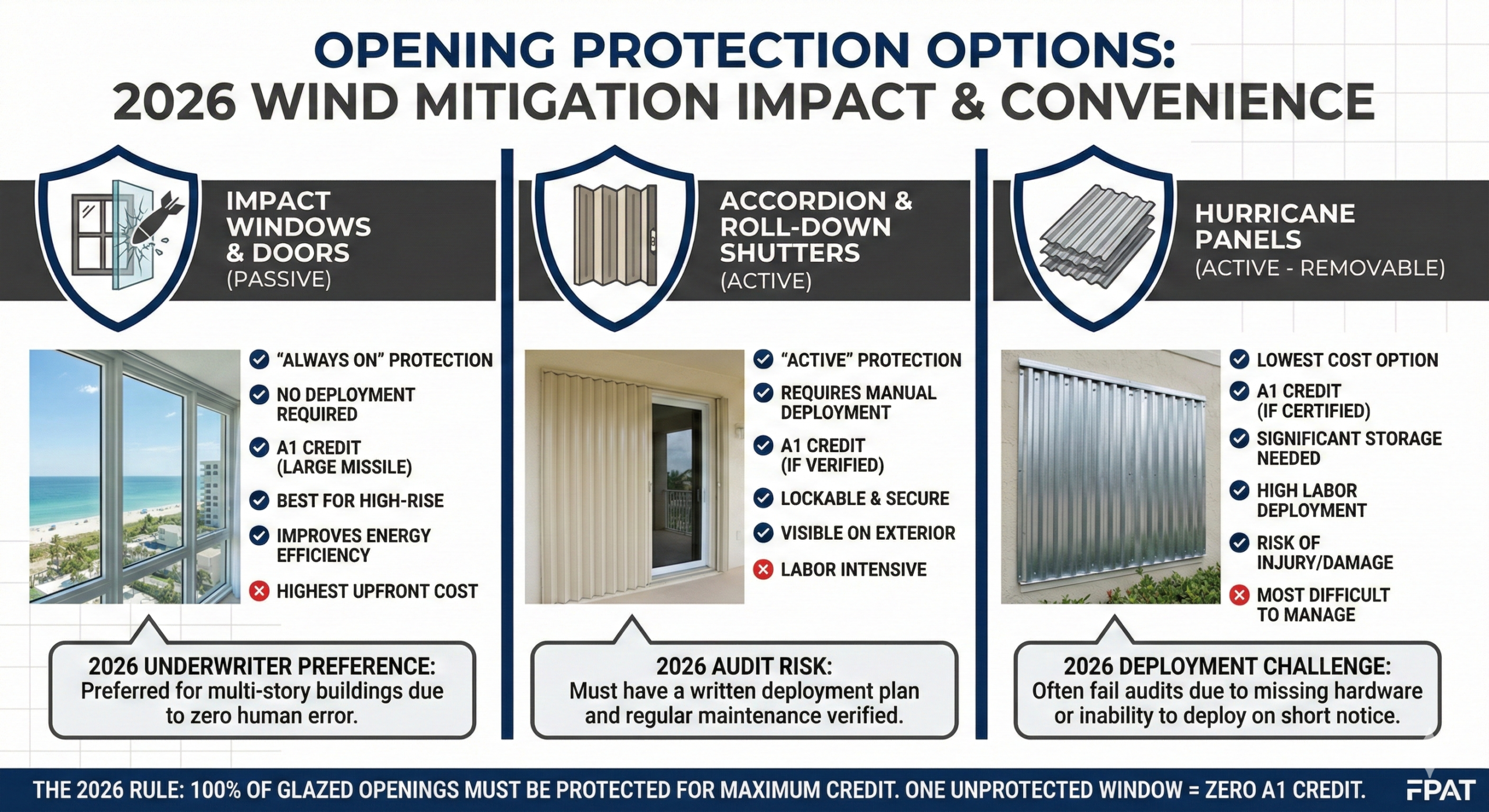
Why Underwriters Prioritize Impact Glass
The primary reason for credit denial in 2026 isn't the quality of the shutter, but the failure to deploy it correctly during a storm. Impact-rated windows and doors provide passive protection — always active without human intervention.
Opening Protection FAQ
Yes. Impact windows usually receive the highest credit ("A1" rating) because they are passive protection. Shutters can also qualify for the full credit, but only if they are properly deployed before a storm. Many 2026 underwriters give stronger preference to impact glass.
Yes, you can mix them. However, every glazed opening must be protected to receive the full Opening Protection credit. Any unprotected window will disqualify the entire building from the maximum discount.
Florida recommends updating your wind mitigation inspection every 3–5 years, or anytime significant renovations (new windows, roof, or doors) are completed. Insurance carriers often require a new inspection if the report is older than 5 years.
Large Missile protection (required in most of Florida’s coastal areas) must withstand a 9-pound 2x4 traveling at 50 mph. Small Missile protection (used in some inland areas) only needs to resist smaller debris. Most Fort Myers, Miami, and coastal associations require Large Missile rated systems.
